
Genetic Testing for Prostate Cancer
Genetic testing for prostate cancer to assess your inherited risk, done from the comfort of your own home with a simple saliva test.
Genetic testing: Understand your risk of developing prostate cancer
Genetic testing for prostate cancer is a simple saliva test that allows us to analyse your DNA to check for inherited mutations which may place you at a higher risk of developing the disease.
Most prostate cancers occur sporadically, arising by chance with no known inherited cause. In contrast, inherited prostate cancer is the result of gene mutations passed down through families. Genetic testing is used to help identify men with this inherited risk, allowing for earlier monitoring and more targeted medical care.
In this video, urology consultant Mr Luke Stroman explains what genetic testing involves, who it might benefit, and how results are used to support preventive healthcare decisions.
Whether you have a family history of illness or simply want to understand your health better, our clinicians can guide you through the process with clarity, discretion and expert support.
Contact The Urology Partnership today to arrange a genetic test for prostate cancer. Call 0118 920 7040.
What the genetic test looks for
A genetic test looks for certain gene changes, specifically in BRCA1, BRCA2 and HOXB13, which are linked with a higher risk of aggressive or early-onset prostate cancer.
Mutations in the BRCA1 and BRCA2 genes are also linked with an increased risk of developing other forms of cancer such as breast, ovarian and pancreatic cancers.
Understanding whether you carry these mutations provides peace of mind for you and your family; or vital information that supports decisions on screening, risk reduction and treatment.
Who should take the test?
Genetic testing is suitable for men who do not have prostate cancer but are considered at risk of developing it if they have:
- A close relative (father, brother, son) diagnosed with prostate cancer.
- A family history of cancers linked to inherited risk, such as breast, ovarian or pancreatic cancer.
- Known mutations in BRCA1, BRCA2, HOXB13 or Lynch syndrome genes in your family.
- Ashkenazi Jewish ancestry, where BRCA mutations are more common.
Genetic testing is also used for individuals with prostate cancer to help tailor treatment, especially for those with advanced disease.
If you’re unsure whether testing is right for you, our prostate cancer specialists can offer personalised guidance based on your history and concerns.
Please call us on 0118 920 7040 to book a consultation or for help and advice.
Why get a genetic test for prostate cancer?
Genetic testing gives you actionable knowledge about your prostate cancer risk – knowledge that can make a meaningful difference to your long-term health outcomes.
- Early detection saves lives: Men with inherited gene mutations such as BRCA2 face a significantly higher risk of aggressive, early-onset prostate cancer. Knowing your status allows for earlier, more frequent screening – which dramatically improves the chances of catching any cancer at a treatable stage.
- Informed decisions for you and your family: A positive result doesn’t just affect you. It means close male relatives may also benefit from testing, giving your family the opportunity to take proactive steps together.
- Personalised care and treatment: For men already diagnosed with prostate cancer, genetic results can directly influence treatment choices. Certain mutations respond particularly well to targeted therapies, meaning your care can be tailored more precisely to your biology.
- Peace of mind either way: A negative result provides genuine reassurance that your risk isn’t elevated due to these inherited genes. And even a positive result puts you in control – with a clear pathway and specialist support from The Urology Partnership team.
- Simple, discreet and done at home: The test requires only a saliva sample and can be completed in your own time. There are no needles, no clinic visit required and no disruption to your day.
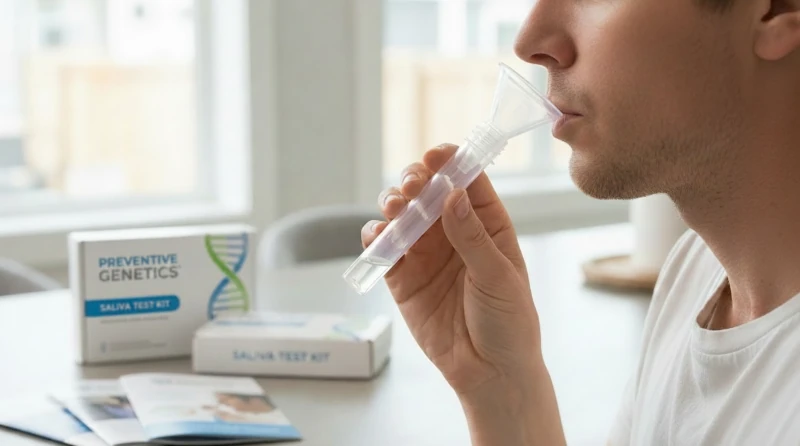
Genetic Testing for Prostate Cancer Procedure
How we conduct genetic testing for prostate cancer
When you’ve requested your test, we’ll send an easy-to-use saliva collection kit to your home. Alternatively, you may collect your test from our Reading clinic.
Inside the kit you’ll find everything you need to complete the test, along with simple to follow instructions.
Once done, return your sample in the prepaid envelope provided and your DNA will be analysed by a laboratory for genetic changes.
Getting your results
Results are typically available within 4 to 6 weeks. You will then receive a detailed report by post covering one of three outcomes:
- A positive result: Means you have a gene mutation that increases your risk for certain cancers including prostate cancer. This does not guarantee you will get cancer, but it allows for proactive steps like more frequent screenings or risk-reducing treatments.
- A negative result: The gene mutations tested for were not found. This means your risk is not higher due to these specific inherited genes.
- Variant of unknown significance (VUS): An alteration was found, but it’s not yet known if it increases cancer risk.
Where a positive result or VUS is identified our team can advise on appropriate next steps .
Ready to understand your risk? Request your test today
Convenient and discreet genetic testing for prostate cancer is available at The Urology Partnership, operating out of The Forbury Clinic facilities at 11 Kendrick Road in Reading, Berkshire.
Please use the form below to request a test or call 0118 920 7040.
See details of our fees for consultations, diagnostics and treatments.
Genetic Testing for Prostate Cancer FAQs
No – the genetic test for prostate cancer used by The Urology Partnership is a simple saliva test.
Yes – the test is designed to be convenient and can be done at home. If you prefer to take the test at our Clinic, we can also arrange this for you
Results are usually available within 4 to 6 weeks. Once ready a detailed report will be sent to you by post.
If your result is positive, it may be relevant for close male relatives – particularly your father, brothers or sons – to consider genetic testing. Female relatives may also wish to discuss testing, as mutations such as BRCA1 and BRCA2 are linked to breast and ovarian cancer.
We recommend sharing your results with your GP and encouraging family members to speak with their own doctors. Our team can also advise on next steps.
You typically only need to get a genetic test for cancer once because your genetic makeup doesn’t change.
However, you may need follow-up genetic testing if a new gene variant associated with cancer is discovered, new technology is available, or the initial test didn’t cover all relevant genes. In which case a check-in every five years is a common recommendation.
Genetic testing for prostate cancer is available on the NHS in certain circumstances, typically where there is a strong family history or an existing diagnosis. However, access can be limited and waiting times may be significant. The Urology Partnership offers private genetic testing with rapid turnaround and specialist support, without the need for a GP referral.
A positive result means you carry a gene mutation that increases your risk – it does not mean you have cancer. Our consultants will work with you to agree an appropriate monitoring plan, which may include more frequent PSA testing, MRI surveillance or other screening. The aim is to detect any changes at the earliest possible stage, when treatment is most effective.
In the UK, insurers are currently bound by the Association of British Insurers’ voluntary moratorium, which means you are generally not required to disclose a predictive genetic test result when applying for most life insurance policies up to a certain value. However, rules can change and individual circumstances vary. We recommend checking with your insurer or a financial adviser before taking the test if this is a concern.
Next Steps
Get fast access to leading specialists for the swift diagnosis and treatment of urological conditions in a private clinic environment.
If you would like more information or wish to arrange a consultation with one of our specialist consultant urological surgeons then please either Call 0118 920 7040 or complete the form below.
Insured patients
Contact your GP and ask for a referral to the Urology Partnership.
All consultations, investigations and treatments are covered by major insurance companies (depending on policy).
Funding your own treatment
Self-funding initial consultation fee is £250. Follow up fees are £175.
Consultation charges are exclusive of any tests and other investigations that the consultant may wish to carry out.
Reviewed by
Reviewed by: Mr Luke Stroman, Consultant Urological Surgeon
Date published: 02 July 2026
Date modified: 02 July 2026
Last reviewed: 02 July 2026