
TURP
Transurethral resection of the prostate (TURP) surgery at The Urology Partnership reduces the size of an enlarged prostate gland, helping to significantly relieve BPH symptoms such as poor stream, urgency or inability to empty the bladder.
TURP Surgery: Find long-lasting relief from BPH symptoms
Transurethral resection of the prostate (TURP) is the gold-standard surgical treatment for benign prostatic hyperplasia (BPH). It offers significant, long-lasting relief from urinary obstruction by removing excess prostate tissue and helping restore the natural flow of urine.
TURP works by surgically removing the inner portion of the enlarged prostate that’s compressing the urethra – similar to removing the core of an apple. Widening this channel relieves the urinary symptoms caused by BPH, such as weak flow, straining and frequent, urgent urination.
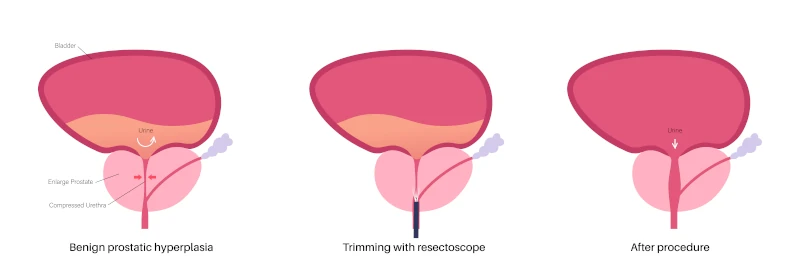
This surgery is typically recommended for treating an enlarged prostate when symptoms are moderate to severe, and where other treatments such as medication or minimally invasive procedures are no longer effective.
It’s a highly effective procedure which offers patients with an enlarged prostate several benefits:
- Improved urine flow
- Reduced frequency, urgency and nocturia
- Better bladder emptying
- Reduced urinary retention risk
- Minimally invasive surgery option with no external incisions
- Long-term symptom relief
To find out if you’re a suitable candidate for TURP surgery book a private consultation with one of our specialists at The Urology Partnership. Call 0118 920 7040.
Appointments are available at our private clinics in Reading or London.
Who is a suitable candidate for TURP?
TURP is generally considered a good option for men with moderate to severe lower urinary tract symptoms (LUTS) that have not responded adequately to lifestyle changes or medication.
It is usually recommended in instances of:
- Failed medical therapy: Persistent urinary symptoms despite the use of alpha-blockers or 5-alpha reductase inhibitors.
- Prostate volume: Prostate glands between 30g and 80g.
- Urinary retention: Experience of “acute urinary retention” (the inability to pass urine).
- Secondary complications: Candidates who develop bladder stones, recurrent urinary tract infections (UTIs), or persistent blood in the urine (haematuria) due to an enlarged prostate.
When might TURP not be suitable?
While TURP is highly effective, it may not be the first choice for everyone. Factors that may lead our consultants to recommend alternative treatments include:
- Very large glands (>80g): These may require Aquablation or laser enucleation (HoLEP) to ensure complete removal and minimise bleeding.
- Focus on sexual function: For men specifically concerned about preserving ejaculatory function, minimally invasive options like Aquablation, Echolaser, UroLift or Water Vapor Therapy (Rezum) may be discussed.
- General health constraints: Patients who cannot safely undergo general or spinal anesthesia, or those on certain blood-thinning medications, may require specialised laser alternatives.
How does TURP compare with other BPH treatments?
Choice of BPH treatment is very personal and will often depend not just on size of the prostate and symptoms, but also patient goals. At The Urology Partnership, our consultants will always take these into account when discussing and recommending suitable BPH treatment options with you.
| Treatment | Best for... | How it works | Ejaculation preservation | Recovery & Stay |
|---|---|---|---|---|
| TURP | Moderate-sized glands (30-80g) with traditional symptoms. | The "Gold Standard." Uses an electric loop to resect (shave) tissue. | Low (Approx. 75% experience dry orgasm) | 1-2 nights in hospital; rapid return to activity |
| HoLEP | Large or very large glands (>80g); patients on blood thinners. | High-powered laser to "peel" away the entire obstructing core. | Low (Similar to TURP) | 1 night in hospital; rapid return to activity. |
| UroLift® | Men prioritizing sexual function; small to medium glands. | Small permanent implants "staple" the prostate lobes open. | Very High (Almost 100% preservation) | Day case (home same day); fastest recovery. |
| Rezūm™ | Medium glands; men wanting a natural, non-implant option. | Uses sterile water vapor (steam) to shrink prostate tissue. | High (Approx. 95% preservation) | Day case; symptoms improve over 1-3 months. |
| Aquablation | Any prostate size; men wanting robotic precision. | Heat-free, robotic water-jet guided by real-time ultrasound. | Moderate-High ( About 10%, Better than TURP/HoLEP) | 1 night in hospital; very consistent results. |
Is TURP right for you?
At The Urology Partnership we recognise that every patient is different. Our consultant urologists will review your symptoms, test results and medical history before making any recommendation.
Book a consultation today to discuss your situation in a confidential, private setting. Call 0118 920 7040.

TURP Procedure
TURP is a surgical operation conducted under a general or spinal anaesthetic, performed by or supervised by a consultant urological surgeon.
The surgery usually takes 45 to 60 minutes and involves:
- Access without incisions: Your surgeon inserts a resectoscope (a thin, lighted tube with a camera and cutting tool) through the tip of the penis and up the urethra to the prostate, meaning no external skin incisions are made.
- Removing tissue: An electrical wire loop at the end of the instrument cuts away the obstructive, inner part of the prostate gland.
- Clearing the area: The removed tissue pieces are flushed into the bladder and removed at the end of the operation.
- Result: A wide channel is created, allowing urine to flow easily from the bladder.
- Sample analysis: A small sample of the removed prostate may be sent for laboratory testing to check for things like cancer.
Recovery after TURP
- Catheter: A urinary catheter is usually inserted post-surgery to help you urinate. We will remove this at an appropriate time after surgery (normally within 1 to 7 days).
- Hospital stay: You’ll usually need to stay in hospital for 1 to 2 days. Occasionally TURP may be performed as a day-case.
- Healing Time: Full recovery typically takes around 3 to 6 weeks. Most patients need 2 to 3 weeks at home before returning to work. If your job is physically demanding you may require 3 to 4 weeks rest before going back to work.
- Urinating: Some blood in the urine is normal for 10 to 14 days. Temporary mild burning and frequent urination may also be experienced.
- Aftercare: Heavy lifting, intense exercise or having sex should be avoided for 4 to 6 weeks.
- Fluids: Drink plenty of fluids (twice as much as normal) for the first few days after a TURP to flush through your system and reduce the possibility of bladder infection.
- Medication: Take any antibiotics or tablets provided as prescribed to help with pain relief and avoiding infection.
- Pelvic floor: Start pelvic floor exercises as soon as you can, to help you regain control of your bladder.
- Follow-up: Results of the tissue analysis are usually available within three weeks.
⚠ If you have severe bleeding, pass blood clots or have sudden difficulty passing urine, you should contact your GP or The Urology Partnership immediately; this may require re-admission as an emergency.
Possible risks and complications
As with all surgery there are potential risks and side-effects associated with TURP. Your consultant will discuss the chance of any complications occurring and what can be done to help.
While rare, potential risks and complications associated with TURP include:
- Bleeding or infection: Some blood in the urine is common after surgery, but heavy bleeding during or shortly after TURP is rare. As with any procedure, there is also a small risk of infection.
- Persistent urinary symptoms: Some men may continue to experience problems with urination after surgery, including difficulty passing urine or urinary frequency.
- Urinary incontinence: In rare cases, men may permanently lose control of their bladder and require ongoing catheter use.
- Retrograde ejaculation: Semen enters the bladder instead of leaving through the penis during ejaculation. This does not usually affect sexual pleasure, but it can affect fertility.
- Erectile dysfunction: A small number of men may experience difficulty getting or maintaining an erection after TURP.
- Prostate regrowth: Around 10% of men may need further treatment or repeat TURP within 10 years if the prostate tissue grows back.
- Unexpected findings: In some cases, prostate cancer or bladder cancer may be discovered during the procedure, or later when the removed prostate tissue is examined in the laboratory. If this happens, your consultant will discuss findings and next steps with you.
What are the TURP success rates?
TURP is considered the gold standard surgical treatment for an enlarged prostate, with the majority of men experiencing a significant improvement in urinary symptoms and quality of life after surgery.
- Significant symptom improvement: Studies show TURP can improve urinary symptom scores by around 70 – 80%, helping men pass urine more easily and reduce symptoms such as frequency, urgency and poor flow. (Porto et al., 2024; McNicholas and Kirby, 2011)
- Improved urine flow: Research has demonstrated major improvements in urinary flow rates following TURP, with many men noticing a stronger stream and better bladder emptying within weeks of surgery. (Porto et al., 2024; Gilling et al., 2019)
- Long-lasting results: TURP offers durable long-term outcomes, with studies showing most men continue to benefit from surgery for many years. Around 10% may require further treatment within 10 years due to prostate regrowth. (Porto et al., 2024; Hoekstra et al., 2010)
- High patient satisfaction: TURP remains one of the most effective and well-established treatments for relieving urinary symptoms caused by BPH, with consistently high satisfaction rates reported in clinical studies. (Porto et al., 2024; McNicholas and Kirby, 2011)
TURP surgery at The Urology Partnership
The Urology Partnership offers men with an enlarged prostate fast access to private TURP surgery for long-lasting relief from BPH symptoms.
Our team of consultant urological surgeons are here to help you with personalised treatment plans delivered using the latest medical innovations and techniques, with the support of a team committed to providing the highest standards of healthcare.
Book an appointment today to discuss your suitability for TURP. Call 0118 920 7040.
TURP FAQs
Several different treatment paths are available to men with an enlarged prostate, which may be more suitable depending on symptoms and personal health goals.
- The “Preservation” Path (UroLift & Rezūm): These are minimally invasive, often done under local anesthetic or light sedation. They are the primary choice for patients whose absolute priority is maintaining normal sexual function and who want to avoid a hospital stay.
- The “Precision” Path (Aquablation): This is ideal for patients who want the reliability of a surgical resection (like TURP) but with a higher chance of preserving ejaculation and the consistency provided by robotic mapping.
- The “Comprehensive” Path (HoLEP & TURP): These provide the most significant and durable relief for urinary flow but are likely to reduce ejaculation. HoLEP, in particular, is the specialist choice for men with very large prostates who might otherwise require more invasive open surgery.
Suitability for these treatments depends on a detailed assessment of the prostate’s shape and size, which our consultants determine during a diagnostic consultation.
To book a private consultation at The Urology Partnership, please call 0118 920 7040.
TURP does not usually affect sexual pleasure or the ability to have erections. However, around 65% to 75% (about 7 in 10) men experience retrograde ejaculation, where semen travels into the bladder rather than leaving through the penis during orgasm. This is harmless but can affect fertility. (British Association of Urological Surgeons, 2023)
The procedure itself is performed under general or spinal anaesthetic, so you will not feel pain during surgery. Afterwards, you may experience mild burning or discomfort when passing urine for a short period while the area heals.
Yes. TURP removes the part of the prostate that is blocking urine flow, but it does not remove the entire prostate gland. Over time, the remaining tissue can continue to grow, which means some men may develop urinary symptoms again. Around 10% of patients require further treatment within 10 years.
TURP is commonly performed in older men and is considered a safe and effective treatment for urinary symptoms caused by an enlarged prostate. Suitability depends more on your overall health, medical history and fitness for surgery than your age alone. Your consultant will assess whether TURP is the best option for you.
Most men who undergo TURP are aged between 60 and 80 years old. Benign prostate enlargement becomes more common with age, particularly in men over 50, and TURP is often recommended when symptoms begin to significantly affect quality of life.
Many men notice an improvement in urine flow within days of surgery, but it can take several weeks for urination to feel completely normal. During recovery, it is common to experience urinary frequency, urgency, mild burning or small amounts of blood in the urine. Most symptoms gradually improve within 4 to 6 weeks.
Next Steps
Our TURP Specialists




Clinical References
Porto, J.G., Bhatia, A.M., Bhat, A., Suarez Arbelaez, M.C., Blachman-Braun, R., Shah, K., Malpani, A., Lopategui, D., Herrmann, T.R.W., Marcovich, R. and Shah, H.N. (2024) ‘Evaluating transurethral resection of the prostate over twenty years: a systematic review and meta-analysis of randomized clinical trials’, World Journal of Urology, 42(1), p. 639. Available at: https://doi.org/10.1007/s00345-024-05332-3
McNicholas, T. and Kirby, R. (2011) ‘Benign prostatic hyperplasia and male lower urinary tract symptoms (LUTS)’, BMJ Clinical Evidence, 2011, p. 1801. Available at: https://pmc.ncbi.nlm.nih.gov/articles/PMC3217770/ (Accessed: 6 July 2026).
Gilling, P., Barber, N., Bidair, M., Anderson, P., Sutton, M., Aho, T., Kramolowsky, E., Thomas, A., Cowan, B., Kaufman, R.P., Trainer, A., Arther, A., Badlani, G., Plante, M., Desai, M., Doumanian, L., Te, A.E., DeGuenther, M. and Roehrborn, C. (2019) ‘Two-year outcomes after Aquablation compared to TURP: efficacy and ejaculatory improvements sustained’, Advances in Therapy, 36, pp. 1326–1336. Available at: https://doi.org/10.1007/s12325-019-00952-3
Hoekstra, R.J., Van Melick, H.H.E., Kok, E.T. and Bosch, J.L.H.R. (2010) ‘A 10-year follow-up after transurethral resection of the prostate, contact laser prostatectomy and electrovaporization in men with benign prostatic hyperplasia; long-term results of a randomized controlled trial’, BJU International, 106(6), pp. 822–826. Available at: https://research-information.bris.ac.uk/en/publications/a-10-year-follow-up-after-transurethral-resection-of-the-prostate/ (Accessed: 6 July 2026).
British Association of Urological Surgeons (2023) Transurethral Resection of the Prostate (TURP) for Benign Disease (Leaflet No. E23/109). Available at: https://www.baus.org.uk/_userfiles/pages/files/Patients/Leaflets/TURP%20for%20benign.pdf (Accessed: 6 July 2026).
Get fast access to leading specialists for the swift diagnosis and treatment of urological conditions in a private clinic environment.
If you would like more information or wish to arrange a consultation with one of our specialist consultant urological surgeons then please either Call 0118 920 7040 or complete the form below.
Insured patients
Contact your GP and ask for a referral to the Urology Partnership.
All consultations, investigations and treatments are covered by major insurance companies (depending on policy).
Funding your own treatment
Self-funding initial consultation fee is £250. Follow up fees are £175.
Consultation charges are exclusive of any tests and other investigations that the consultant may wish to carry out.
Reviewed by
Reviewed by: Mr Luke Stroman, Consultant Urological Surgeon
Date published: 24 January 2020
Date modified: 09 July 2026
Last reviewed: 02 July 2026